
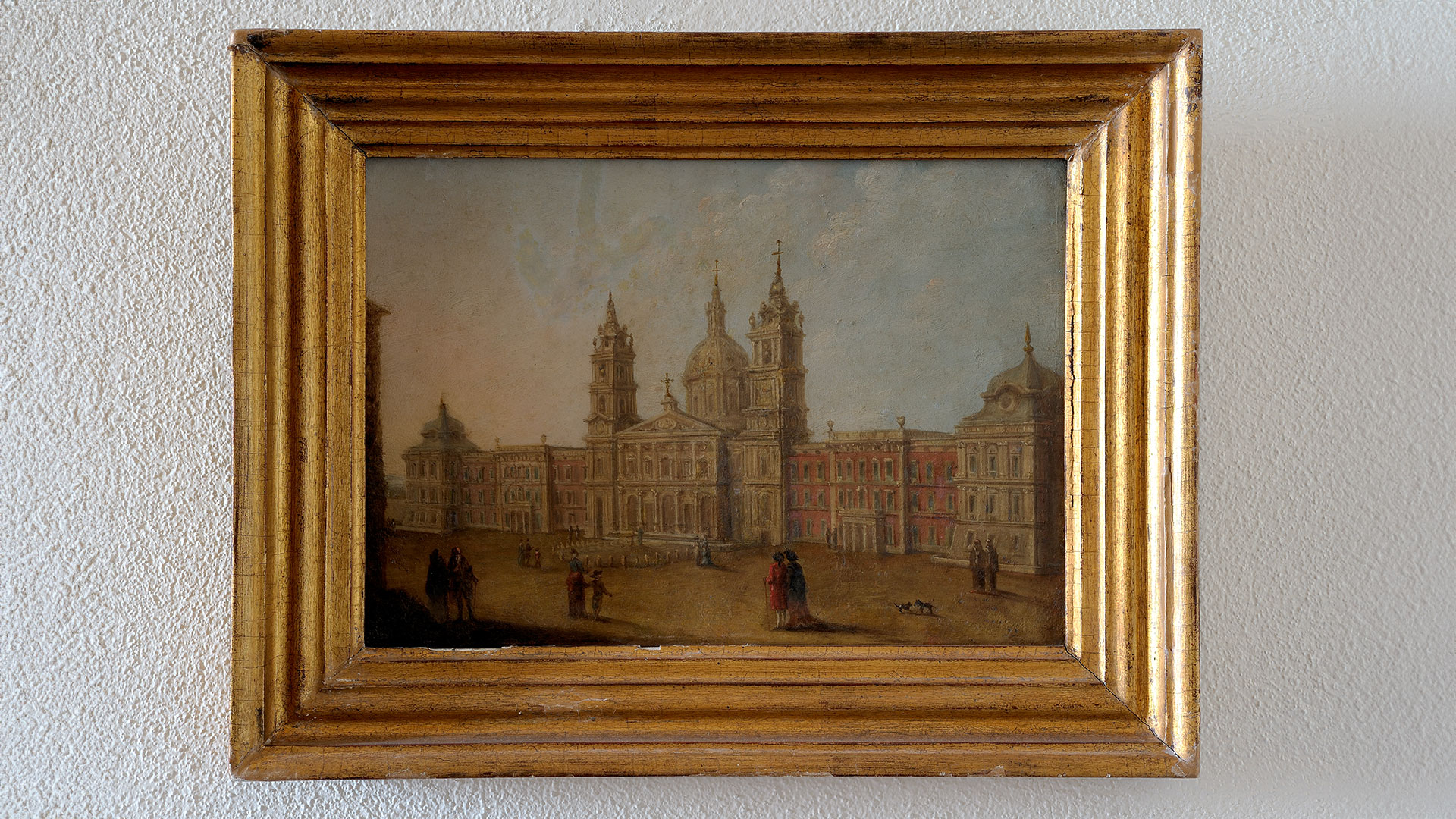
THE IDEIA OF THE MAFRA MONUMENT
The Mafra monument was modelled on Heliopolis, the City of the Sun. When he said it was a microcosm of Baroque Rome in Portugal, Robert Smith would admit something equivalent.
The Mafra Monument is a living example of a peculiar way of conceiving and bearing witness to the national millenarian and eschatological tradition. Explained with impeccable iconographic rigour, the surprising iconological programme defined by King João V is anything but obvious to the invariably unprepared observer.
Because it is the House of God, the space of a temple is expressly designed to enable humanity to come into contact with the transcendent divinity but also with the immanent. As such, it manifests a complex universe of cosmological, ideological and faith references embodied in symbols and liturgies (which are still symbols). Their legibility will be all the more effective the more proficient the observer is in their simultaneous knowledge of the dogmas and systems of ideas underlying the forms (geometric, arithmetic, etc.) and in their control and ability to direct their intuition towards them.
If such an undertaking is complex when dealing with the symbolism of a temple, it will be much more problematic when, as is the case here, the same sanctuary is destined for God and claimed by the King for his dwelling.
One of the repercussions of this idea in the Mafra Monument is emphasised by the repeated allusion to the duodecimal division, whose doctrinal importance was underlined by Luke (VI, 13-17) and Matthew (X, 2), embodied in the 12 porticoes of the building, the 12 Apostles of the Lamb, present in the Galilee of the Basilica, or the 12 x 12 [144 = Holy Jerusalem] coins thrown by the Magnanimous One's almsman on the foundation stone. However, the impact of sacred numerology on the Mafra Monument is not limited to this number. Another recurring number, traditionally associated with national eschatology, is also worth mentioning. It's the number 17, in this form, in the form of one of its multiples (34, 51, etc.), or even in the form of its secret value, 153, which expresses the sum of the values of the names of the Apostles, the foundation of the Holy City (i.e. 1530), according to Matthew (9 x 170 [= New Jerusalem]) and Luke (10 x 153 [= The Spirituals]).
Furthermore, to properly decode the Mafra Monument, it is essential to repeatedly refer to the Apocalypse attributed to the seer of Patmos, and in particular to the statements dedicated to the New or Heavenly Jerusalem by exegetes, a significant number of whom have proposed reconstructing it in the image of its prototype, Solomon's Temple.
In this same light, it's impossible to ignore the symptomatic and omnipresent insistence of the Magnanimous One's contemporaries, but also of the panegyrists on duty, on the attribution of the Basilica of Mafra to the Solomon of the Law of Grace (Dom João V), for the tabernacle of St Anthony, by antonomasia called the Ark of the Testament, which is to say the Ark of the Covenant.
