
FRAGMENTS OF A MEDIEVAL ALTARPIECE
Donation of Mafra to Dom Nicolau, Bishop of Silves by D. Sancho I and D. Dulce [ANTT: CR, Santa Cruz de Coimbra, Docs Regs. Dulce [ANTT: CR, Santa Cruz de Coimbra, Docs. Regs., bundle 2, n. 5]
Undoubtedly, archaeological remains show that Mafra has been inhabited since the Palaeolithic period. The exact circumstances of the expulsion by the forces of Afonso Henriques remain uncertain. The chroniclers are silent about the date, only putting forward a justification regarding the timing of the war, which took place in 1146 or, more plausibly, the following year, 1147.
The earliest known documentary source to refer to it explicitly ("villam quae dicitur Mafarã cum omnibus suis terminus novis et veteribus"), is the parchment that records the respective donation by King Sancho I and Queen Dulce to the diocese of Silves, in the person of Bishop Dom Nicolau and his successors, in 1189. The donation became ineffective, and the town reverted to the Crown after Silves was reconquered by the Muslims in 1191.
Charter of Mafra, granted by the diocese of Silves in 1189 [ANTT: drawer 13, bundle 1, n. 21, p. 3frt-6back]
There was a church in Mafra when the Bishop of Silves granted the town a charter (1189). It would be unthinkable for there not to be a church, especially in a territory dependent on a diocese, and there is also a reference to clergymen, naturally exercising their pastoral duties in the parish of the town: "[...] The clergyman has knighthood status in everything. And if he is found with a woman in a bad way, the steward should not get involved, nor in any way should he take the child, but the woman should take it, if she wishes [...]". The original diploma has been lost, and only a translated copy is known to exist in the Tombo da Terra da Estremadura (January 1396).
Donation of Mafara to the Order of Évora, later called S. Bento de Avis, to whose Master, Dom Gonçalo Viegas (1176-1193), by D. Sancho I, on 1st May 1193 [Arquivo Nacional Torre do Tombo (ANTT): Ordem de Avis, n. 64].
This donation had been the subject of repeated pontifical confirmations from Innocent III (1198-1216) and a royal one, namely: Bula Quotiens a nobis petitur (28 April 1199); Bula Religiosam vitam (17 May 1201); Bula Quotiens a nobis petitur (20 May 1214); a diploma from King Afonso II confirming the donation of Mafra castle (August 1218). Afonso II confirmed to D. Fernando, Master of the Order of Évora, that his father had donated Mafra castle to D. Gonçalo Viegas (August 1218).
Mafra remained in the possession of the same Order of Cavalry until 5 May 1237, when Master Fernando Rodrigues received the castle of Juromenha with its new and old terms, on condition that he returned the town of Mafra to King Sancho II with all the "things that were in the town and the land".
Barter of Portel for Mafra, in 1289 [ANTT: drawer 11, bundle IV, n. 20]
On 9 January 1289, King Dinis gave Mafra to João Fernandes and his wife, Maria Anes de Aboim (daughter of the nobleman and troubadour João Peres de Aboim, c. 1213-c. 1285), in exchange for Portel, which belonged to them, with all its royal rights, including the patronage of the town church.
Under the terms of the agreement, the sovereign was obliged to defend the towns and places he donated with interest and inheritance, forever free and exempt from all tribute and royal service. On the same date, the monarch reformed some of the precepts of the 1189 charter.
The donees had no descendants, and their great-nephew, D. Diogo Afonso de Sousa, succeeded them.
Letter from Dom João I (Santarém, 8th September 1385) ordering the integration of Mafra into the Lisbon Terms [AHML: Livro I de D. João I, doc. 10]
It determines the integration of Colares, Ericeira, Mafra, Vila Verde, as well as all the towns, places and villages located between the Lisbon Terms (limits), Alenquer, Torres Vedras and Sintra into the Lisbon Terms, as a reward for their support in the political and military events of 1384-1385.
THE RECTOR OF THE CHURCH OF MAFRA SIGNS PETITION FOR THE CREATION OF THE GENERAL STUDY (UNIVERSITY) OF LISBON
On 12 November 1288, the Rector of the church of Mafra (still without a clear reference to the respective patron saint) signed, together with the abbot of Alcobaça, the priors of Santa Cruz de Coimbra and S. Vicente de Fora and 23 other rectors of Portuguese churches, a petition addressed to the Pope, asking them to pay the salaries of the Masters and Doctors of the General Study of Lisbon, which was about to be established, from the rents of their monasteries and churches. The content of this petition seems to indicate that it was the petitioners who asked King Dinis for such a foundation, but if Rui de Pina is to be believed, the monarch himself, meeting one day with his prelates and councilmen in Montemor-o-Novo, would have told them that he had planned ("and for this, I proposed days ago in my will") to create a General Study in which all the sciences would be read.
The decree explains how the temple of Maffora was economically unburdened.
DUARTE DE GALVÃO
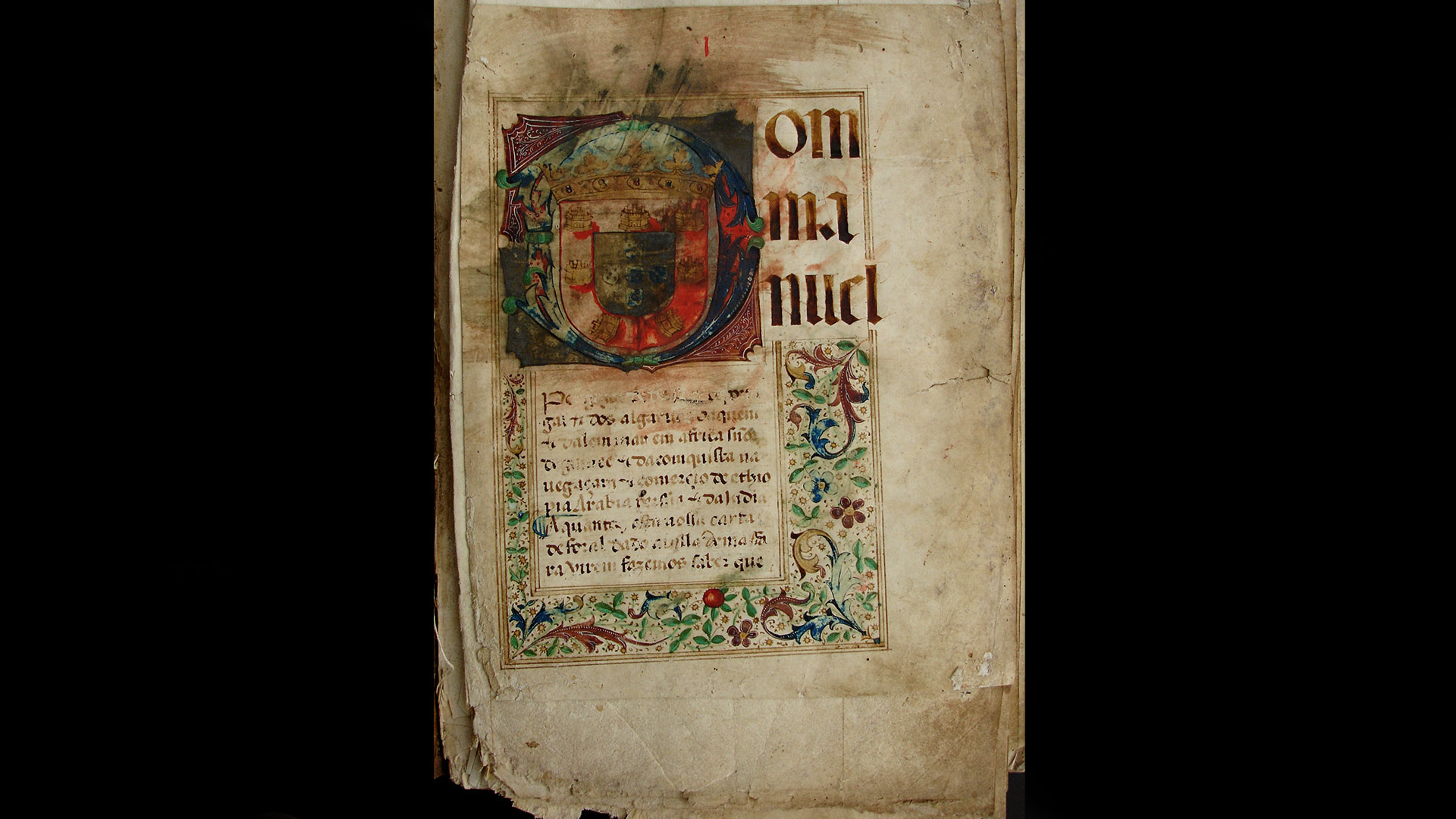
Prologue to the Chronica delrey Dom Affonso Hemrriques
16th century
parchment, illuminated (António Godinho?) ANTT: cod. 345
This chronicle contains the first historiographical reference to the conquest of Mafra by King Afonso Henriques. The author states that it took place in 1147, before Lisbon, narrating the deed in the following terms:
"When the King arrived at the land where Lisbon is situated, he thought it best to go to war and take the fortresses around it before laying siege to the city so that when the siege came, they would have less work to do in foraging, and would be able to spread out across the land more lightly, without other guards; and so he immediately took the castle of Mafra and gave it to D. Fernão Monteiro, the first Master of Aviz in Portugal. And after this, he immediately besieged Sintra and took it [...]' (chapter XXXIV).
António Vitorino França Borges acknowledges that the conquest occurred between 18 and 28 June 1147.
