
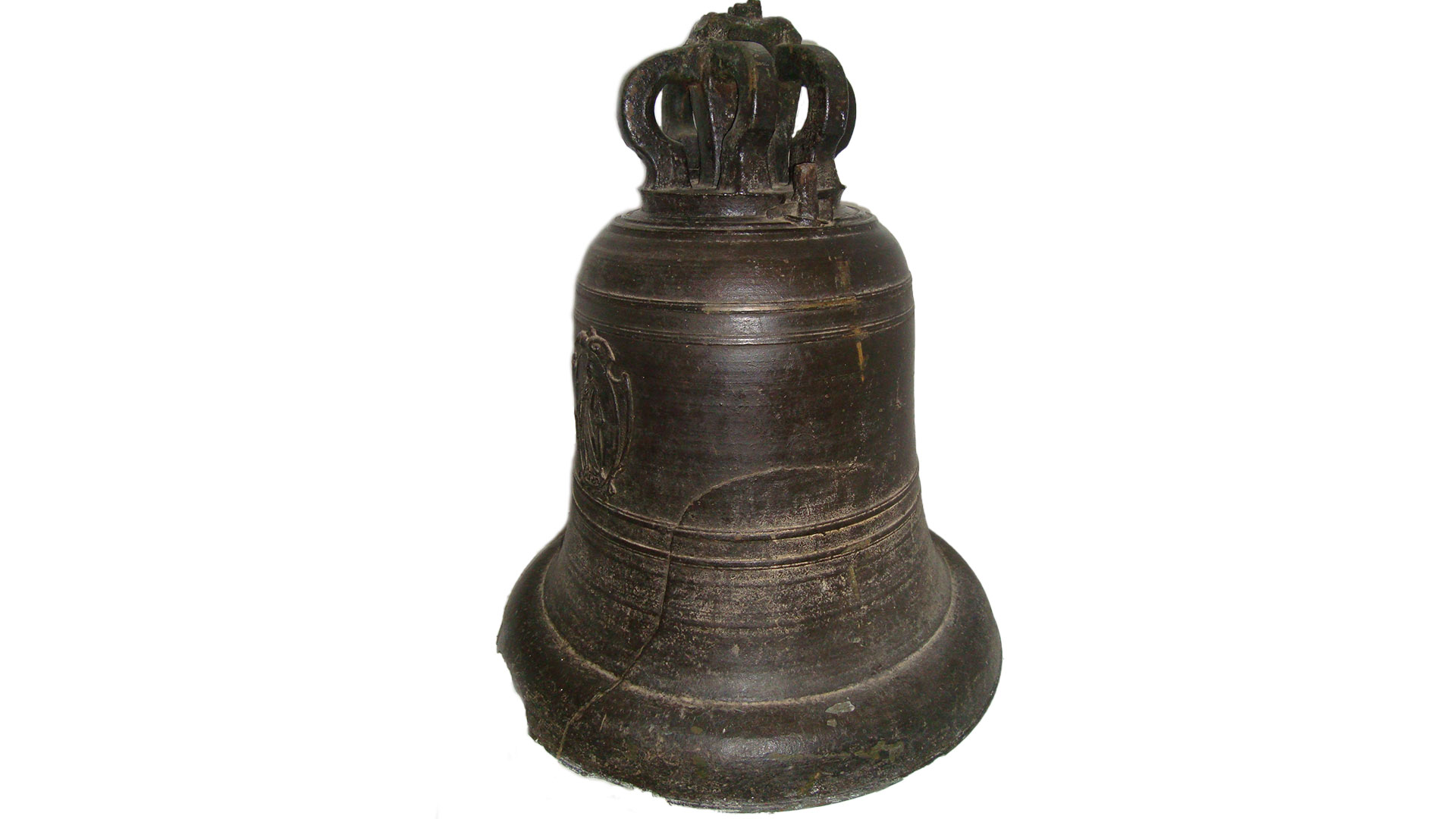
BELL OF THE CHURCH OF SANTO DE ANDRÉ IN MAFRA
Bell
1739
bronze; 800 x ø 700 mm
Prof. Raúl de Almeida Municipal Museum: inv. MM.05283
Everything points to this bell having belonged to the Church of Santo André, rung on festive dates (religious festivities, weddings, baptisms, funerals, etc.), because according to Virgílio Correia, among the ruins of the bell tower of the Church of Santo André, there were two large bronze bells, one of them dated 1739.
Bells occupy a prominent place in religiosity and imagery, replacing the silver trumpets that, in the written Law, called the Israelites to the Tabernacle for sacrifices. They are, in fact, still essential today in celebrating rites of passage: birth, marriage and death, as well as in marking the rhythms of rural life, particularly in defining the times of work and rest (at twilight and midday). This is one of the reasons why, in the Middle Ages, they were labelled according to their function. In wealthier parishes, the church had several bells for specific purposes: the campana, or large bell, hung from the tower or belfry (a tradition introduced, it is said, around the year 400 by St Paulinus, bishop of Nola). Paulinus, bishop of Nola); the squilla or sanctus, a small bell next to the choir that was rung at different times of the religious service; dupla, a bell that marked the hours of the day; cymbalium, a bell in the cloister to give signals to the friars; nolla (or nola), in the refectory; corrigiunculum, rung when someone was punished by flogging. The Roman Catholic Church baptises and blesses the bells, and there is also a blessing of the metal used for the bell over the melting bronze (some bell founders believed that menstrual blood was detrimental to their work, so women were sometimes excluded from a rite that ended with a special prayer for the success of the business). The act of consecrating a bell was preceded by the recitation of various psalms and the blessing of salt and water, accompanied by specific prayers, one of which alluded to the bell's power. The officiant and acolytes would then wash the bell thoroughly, inside and out, and then dry it. Once the washing was complete, the officiant would place a cross on each bell and then another seven, symbolising the seven sacraments of the Church. Then, he made four crosses inside the bell with the Holy Chrism, symbolising the four cardinal points. After other prayers, the prelate would place the turíbulum with incense and other perfumes under the bell until the bell was completely filled with smoke (the Ritual Romanum after 1984 removed all references to the anointing and washing of bells, as well as their power to ward off the devil).
